Friday, 3 October 2014

Spicy Scotch Beef and Tomato Homemade Soup

Spicy Scotch beef and homegrown tomato soup

This is the time of year when many people are harvesting the last of their homegrown food crops from gardens and greenhouses and at the same time starting to think ahead to the darker, colder nights and months of winter that lie not so far ahead. What better then than to consider recipes which both use up some of these homegrown treats and can be frozen for later use to form warming meals on cold nights. That is how this simple, tasty soup recipe came about and I have most of it in my freezer with the intention of taking it in my flask on winter fishing trips.

Fresh greenhouse grown Scottish red and yellow tomatoes

These tomatoes were a present one day last week from a local greenhouse. There was over twelve pounds of them in total but in this instance I used four pounds of the red ones only.

Scotch boiling beef and beef bones

Ingredients

3/4 pound piece boiling beef
1/2 pound additional beef bones
1 large carrot, washed and roughly chopped
1/2 white onion, peeled and halved
1/4 pound mixed sliced bell peppers
1/2 teaspoon dried thyme
1/2 teaspoon dried rosemary
Salt and pepper
5 pints cold water

4 pounds red tomatoes, washed and halved
1/2 teaspoon (approximately) dried oregano
Olive oil for drizzling
2 large, medium strength red chillies, seeded and roughly chopped

Carrot, peppers and onion for making beef stock

Directions

Put the boiling beef and beef bones in to a large soup or stock pot. You really do need such a pot for this as even a big, "ordinary" pot is unlikely to be big enough for even such  a fairly small quantity of soup. These pots are often not as expensive as you may think and can last for many years, being used to make hundreds of batches of stock and/or soup.


Beef, vegetables and seasonings for stock

Add the carrot, bell peppers, onion, rosemary and thyme to the pot and season well with salt and black pepper.

Beef stock ingredients are brought to a simmer

Measure out the five pints of cold water (note that a British pint equals 1.25 US pints so US readers, use 6.25 pints) and pour over the beef and vegetables. Bring to a simmer for two hours.

Beef and bones are removed from stock to cool

Turn off the heat under the pot and use a large slotted spoon to remove the beef and bones only to a bowl. Cover the bones and the stock and leave to cool/partly cool while you roast the tomatoes.

Weighing out tomatoes for roasting

Weigh out the tomatoes and wash them carefully in some lukewarm water in your sink. Dry in a clean tea towel.

Washing tomatoes in lukewarm water

Lay the halved tomatoes on a couple of roasting trays, cut sides up. Season with the oregano and salt and pepper before drizzling with olive oil.

Tomatoes are halved and seasoned for roasting

Roast the tomatoes in a low to moderate oven (150C/300F/Gas Mark 2) for two hours.

Roasted tomatoes

When the tomatoes come out of the oven, they should be shrivelled and although not completely dried out, at least contain considerably less moisture.

Seeded and roughly chopped chilli peppers

Strain your part cooled stock through a sieve and return it to the empty pot before adding the tomatoes and chopped chillies. Bring to a simmer for half an hour.

Tomatoes and chillies are added to strained beef stock

It is never a good idea to blend extremely hot liquids so let the developing soup cool for at least half an hour before blitzing in small batches.

Tomato soup is blitzed until smooth

As each batch is blitzed, pour it through a sieve and in to a large bowl. Use a wooden spoon to help the mixture through the sieve though don't force it. The sieve should collect unprocessed pieces of skin and seeds.

Soup is strained through a fine sieve

You should be left with a smooth and fairly thin soup. I deliberately wanted it fairly thin as it is to be used from a flask. You could use more tomatoes if you want it thicker.

Sieved spicy beef and tomato soup

Carefully pick all the beef from the bones in small pieces.

Beef is picked from cooled bones

Rinse out your soup pot and carefully pour in the strained soup.

Sieved tomato soup and beef are brought back to a simmer

Add the beef to the soup, bring up to a simmer, taste and adjust the seasoning and the soup is ready to eat.

Soup is ladled in to plastic dishes for freezing

I did enjoy a bowl of the delicious soup as soon as it was ready but most of it was allowed to cool before being ladelled in to small plastic dishes for freezing.

Portions of soup ready for the freezer

Monday, 22 September 2014

Homemade Scottish Steak and Kidney Pie with Fresh Garden Veg

Homemade Scottish steak and kidney pie with garden fresh potatoes and carrots

Steak pie in Scotland is of course normally a combination of diced stewing steak and beef link sausages in gravy, topped with puff pastry. Steak and kidney is more often considered an English rather than wider British combination for a pie filling. Since my teens, however, I have preferred steak and kidney pie to traditional Scottish steak pie - though I do love both! This dish is a combination of steak and kidney filling served in the traditional Scottish style steak pie style.

Scottish steak and kidney

Scottish steak and kidney is widely available in Scotland both from butcher's shops and from supermarkets. If you don't see it on display, try asking for it to see if the particular shop has it available. I bought it in this instance from my local Morrisons supermarket.

Baby potatoes and carrots fresh from the garden

The vegetables I served with the steak and kidney pie were gifted me as fresh as fresh can be from a local garden. You will notice that some of the carrots were orange and some were of the much less widely known purple variety.

Ingredients (Serves Two)

1/2 pound (225g) Scottish stewing steak, roughly diced
1/4 pound (110g) Scottish ox kidney, cleaned and roughly diced
1/2 teaspoon dried thyme
Salt and pepper
2 tablespoons vegetable oil
1/2 medium white onion, peeled and sliced
1 pint fresh beef stock
1/4 pound (110g) premade puff pastry
Flour for dusting pastry rolling area and rolling pin
1 small egg, beaten, for glazing pastry
Baby new potatoes (as required)
Baby carrots (as required)
2 ounces (50g or 1/2 stick) butter
1/2 teaspoon ground cumin

Steak and kidney is seasoned and ready for browning

Directions

Pour the vegetable oil in to a large stew pot and gently heat. Add the steak and kidney, seasoning with salt, pepper and the dried thyme. Stir fry over a medium heat for a few minutes until evenly browned and sealed.

Sliced onion is added to browned steak and kidney

Add the sliced onion to the pot and stir for a further minute or so until the onion is just starting to soften.

Steak and kidney is slowly simmered in beef stock

Pour in the beef stock, bring to a simmer and continue to simmer for about an hour or until the steak is just tender. Cover and leave to cool completely.

Cooled steak and kidney is added to pie dish

When the steak and kidney is cool, put your oven on to preheat to 210C/425F/Gas Mark 7.

Use a slotted spoon to lift the steak and kidney pieces to a suitable pie dish. Pour in just enough stock to half cover the meat. If you add too little stock, the meat will dry out in the oven; if you add too much, it will make the underside of the pastry soggy.

Premade Scottish puff pastry

This puff pastry came in a half pound block. I only needed half of it, so the other half went in to a plastic dish and the fridge where it will easily keep for a couple of days. I rolled out the half I needed on a floured board just large enough that it would comfortably cover the pie dish.

Rolled pastry is laid on top of pie dish

I carefully laid the rolled out pastry over the pie dish. I know that very often people will firstly wet the edges of the dish with milk or beaten egg, or perhaps cover them with offcuts of pastry. This is to stop the pastry shrinking during cooking. I never do this as I want the pastry to shrink during cooking. Why? I think it makes the plating up easier and for better presentation when the pie is actually on the plate. It also makes washing the dish afterwards a lot easier...

Pastry is crimped and trimmed

Crimp the pastry around the edges of the dish and trim the excess carefully away with a sharp knife.

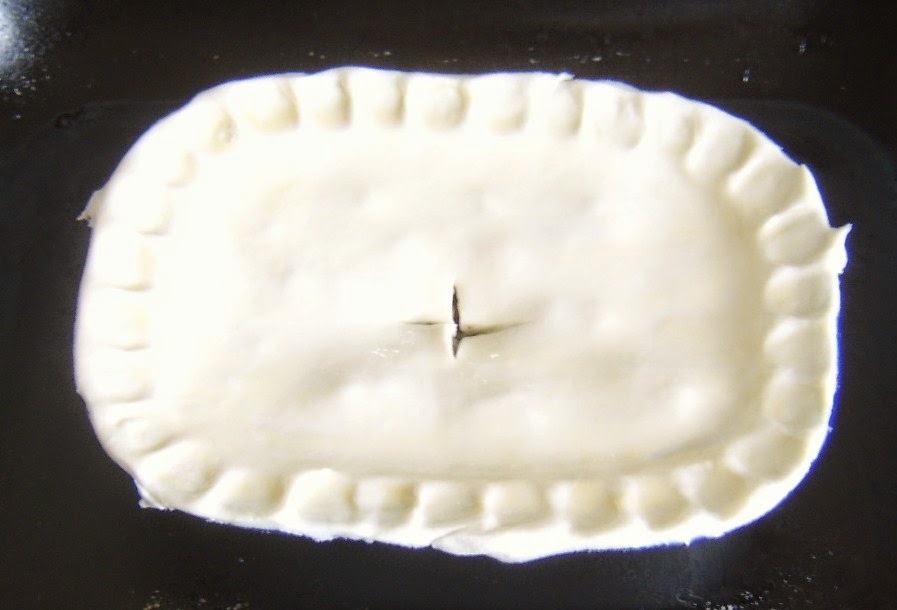
Steak and kidney pie is glazed and ready for the oven

I always sit a pie like this in a deep roasting tray to cook. This is simply in case there is any unexpected leaking of juices during cooking. It's a lot easier to clean a roasting tray than your entire oven!

Glaze the pastry all over with beaten egg and cut a steam vent in the centre. Put the pie in to the oven for 35 to 40 minutes, until the pastry is risen and golden.

Scrubbing baby potatoes and carrots

The potatoes and carrots should be scrubbed in your sink using cold water. Neither, however, should be peeled or even scraped.

Baby new potatoes are put on to boil

Put the potatoes in to a large pot of cold, salted water and bring to a simmer for about twenty-five minutes or until just softened and no more.

Homemade steak and kidney pie removed from the oven

Take the steak and kidney pie from the oven and let it rest for ten minutes or so while you tend to the nearly ready potatoes and the carrots.

Trimming baby carrots for sauteeing

Trim the stalks almost but not not quite completely from the carrots as shown above. Likewise, trim off any straggly ends.

Sauteeing baby carrots in butter and cumin

Melt half the butter (1 ounce) in a small, non-stick frying pan. Add the carrots and season with salt, pepper and the ground cumin. Fry on a medium heat for three or four minutes, gently shaking the pan to turn the carrots every thirty seconds or so.

Butter is added to new potatoes

Drain the potatoes at your sink through a colander, return them to the empty pot and let them steam off for a couple of minutes. Add the remaining butter and gently swirl the pot to melt the butter and evenly coat the potatoes.

Divide the steak and kidney pie between two serving plates before adding the potatoes and carrots.

Steak and kidney pie portion is plated

Saturday, 6 September 2014

Pan Fried Mackerel Fillets with Rhubarb and Ginger Sauce

Mackerel fillets on watercress bed with rhubarb and ginger sauce

Mackerel is one of my favourite eating fish. I love it smoked, fried and even poached. While the mackerel itself is best cooked simply (in whichever way) its rich and powerful flavour can be wonderfully enhanced by a surprising number of different accompaniments.

Freshly caught mackerel fillets

Sadly, mackerel in recent times in the UK has gone the same way as so many other once plentiful types of fish and lost its wholly sustainable classification. Fortunately, this does not mean that we sea fishermen can not take a couple for the pot every now and again. These two mackerel were caught at St Catherines Jetty on Loch Fyne on Thursday before one of them was cooked up for a late dinner as shown below.

Filleting knife and board
In order to fillet your mackerel, you will need simply a large chopping board and a filleting knife.

Starting to fillet mackerel

Lay the mackerel on one side, holding the head with your weaker hand, and make a cut behind the pectoral fin, angled towards the head (see above). Turn the filleting knife and slice along the bone all the way to the tail.

First fillet removed from mackerel

Lift the fillet free, turn the mackerel over and do exactly the same again on the second side.

Cutting bones from mackerel

There is a ridge of bone runs along the centre of the fillets for around two-thirds of their length. This is easily cut away by making two collectively v-shaped cuts and pulling free.

Fillets from fresh mackerel

Wash the mackerel fillets carefully in a bowl of cold water and pat dry with kitchen paper.

Fresh rhubarb

This rhubarb was given to me from a local garden. By a strange coincidence, I love mackerel with rhubarb and hadn't had it for ages. So although most of the rhubarb was cleaned, blanched and frozen, I used one stick to make a sauce for my mackerel.

Rhubarb and ginger sauce ingredients

The rhubarb stalk was trimmed, washed and chopped in to roughly one inch pieces. The pieces went in to a saucepan along with two tablespoons only of cold water, half a teaspoon of sugar (you want some sweetness while retaining the tartness of the rhubarb) and a generous pinch of ground ginger. The saucepan went on to a medium heat until the water started to simmer. At which point, the heat was reduced to achieve the gentlest of simmers for about eight to ten minutes until the rhubarb was mostly broken down. This can be varied according to preference. Stir occasionally with a wooden spoon.

Washing watercress

While the rhubarb is simmering, take two generous handfuls of watercress and rinse under cold water in a colander. Set aside on your draining board to drain.

Rhubarb and ginger sauce for mackerel

When the rhubarb and ginger sauce is ready, turn off the heat and set aside to cool slightly while you fry the mackerel fillets.

Mackerel fillets are patted on skin sides in seasoned flour

Scatter some plain (all purpose) flour on a plate and season with salt and pepper. Bring some vegetable oil up to a fairly high heat in a non-stick saucepan.

Mackerel fillets are firstly fried skin sides down

Pat the mackerel fillets on their skin sides only in the flour and lay away from you in to the hot pan, skin sides down. Season on the flesh sides. Cook for around three minutes until you can see the mackerel is almost cooked all the way through.

Mackerel fillets turned on to flesh sides to complete cooking

Turn the heat off under the pan and the fillets on to the flesh sides to complete cooking for about a minute in the residual heat only.

The perfect dish for serving fish

You may not of course have a fishy shaped dish like this one in which to serve your meal. Simply take an appropriate plate, ideally a deep one if you have one.

Watercress is arranged as a bed for mackerel fillets

Shake any remaining water from the watercress and arrange it on your plate as a bed for the mackerel fillets.

Mackerel fillets are laid on watercress bed

Lay the mackerel fillets skin side up on the bed of watercress. Spoon the rhubarb and ginger sauce alongside.

Crispy skin peels easily from mackerel fillets

The skin should be beautifully crisp, so much so that it will easy lift free from the mackerel flesh in a single piece.

Tucking in to mackerel with rhubarb and ginger sauce